The platform
Entitlement intelligence, parcel by parcel.
Three layers on every report: the rules that apply to your land, the paths to get it entitled, and what each move is worth. Sophisticated underneath. Simple to use.
See it work
The app, recorded live.
Type an address. VALITER reads the public record, finds whose rules apply, and lays out the path to entitled, starting with your next move.
Demo on Texas public records. Decision support, not legal or engineering advice.
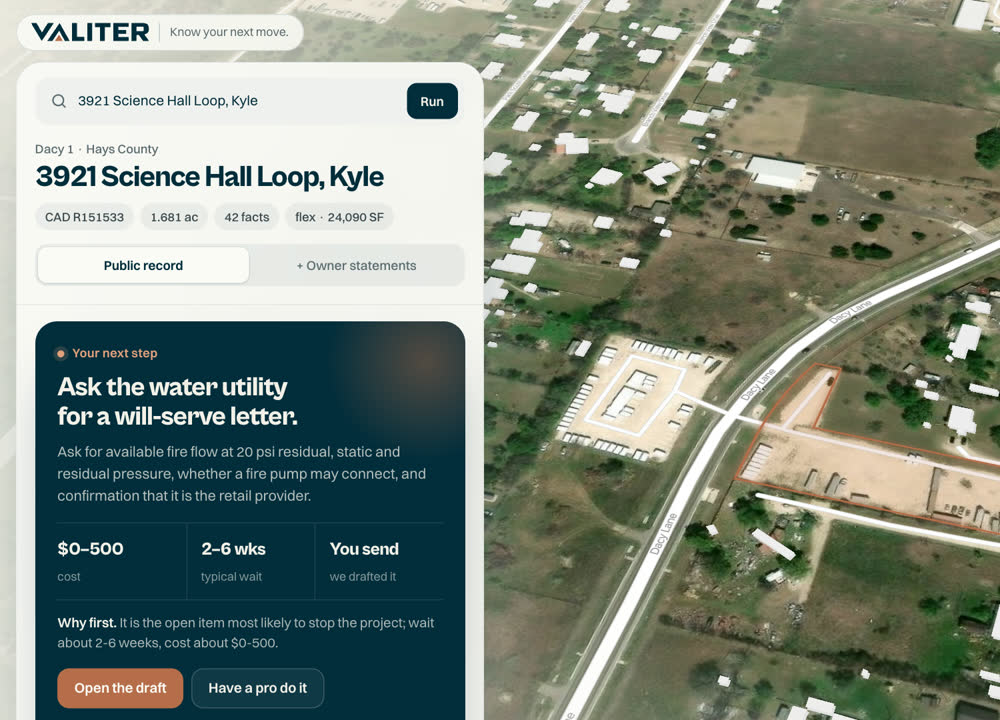
Your next move, first
It leads with the one step most likely to stop the project, with the cost, the typical wait and who acts.
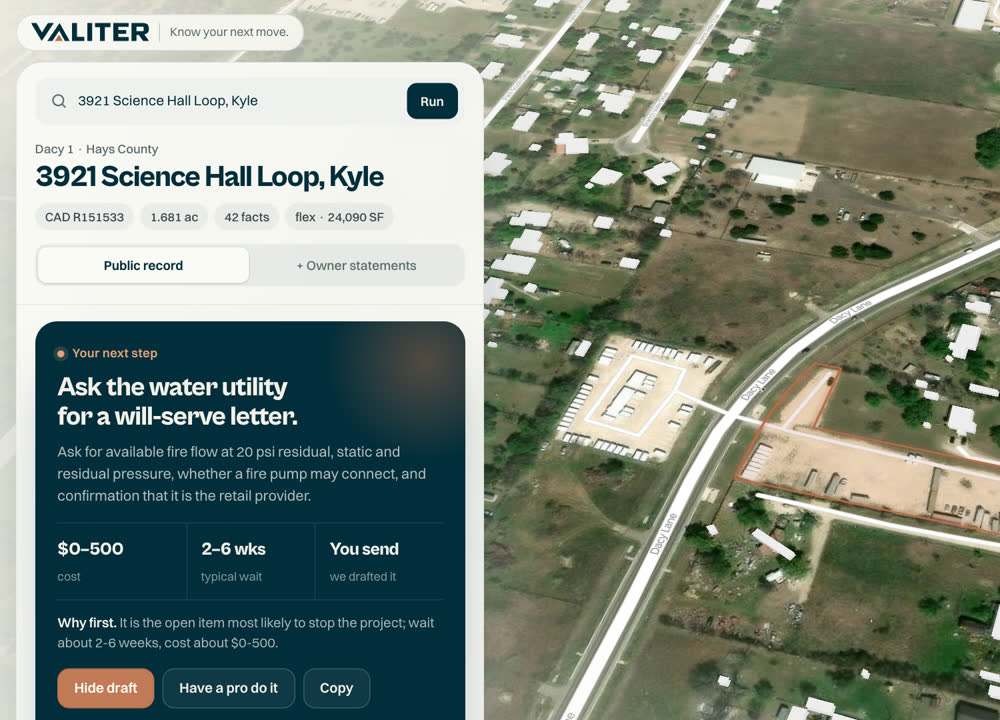
The request, already drafted
The will-serve letter or records request comes written for you to review, copy and send.
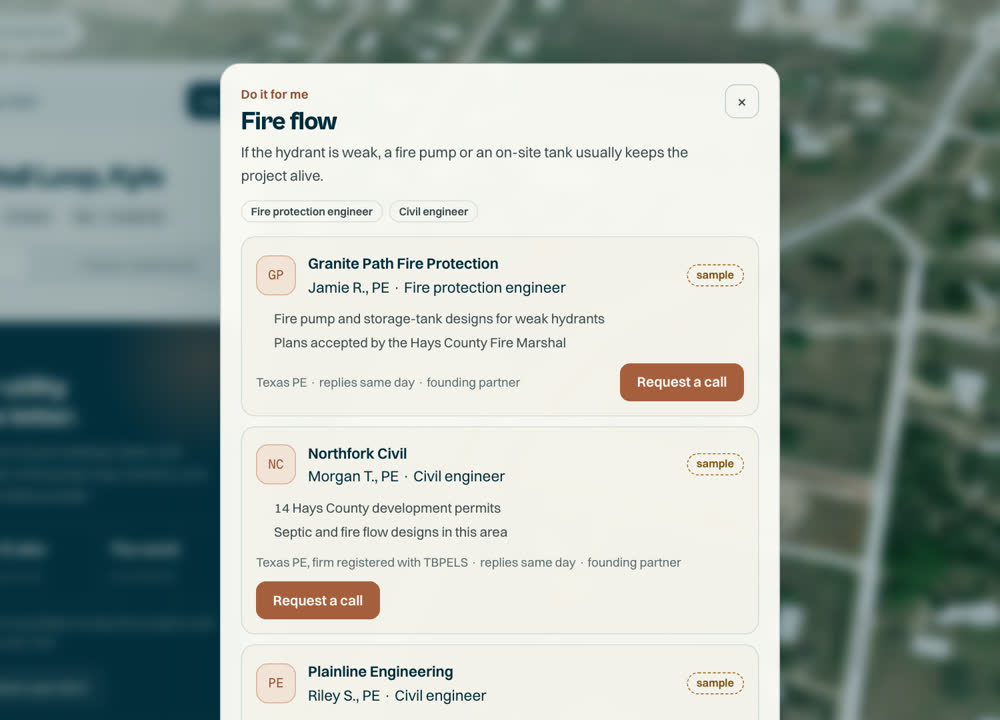
Or have a pro do it
Local engineers and consultants matched to that exact step. Listings shown in the demo are samples.
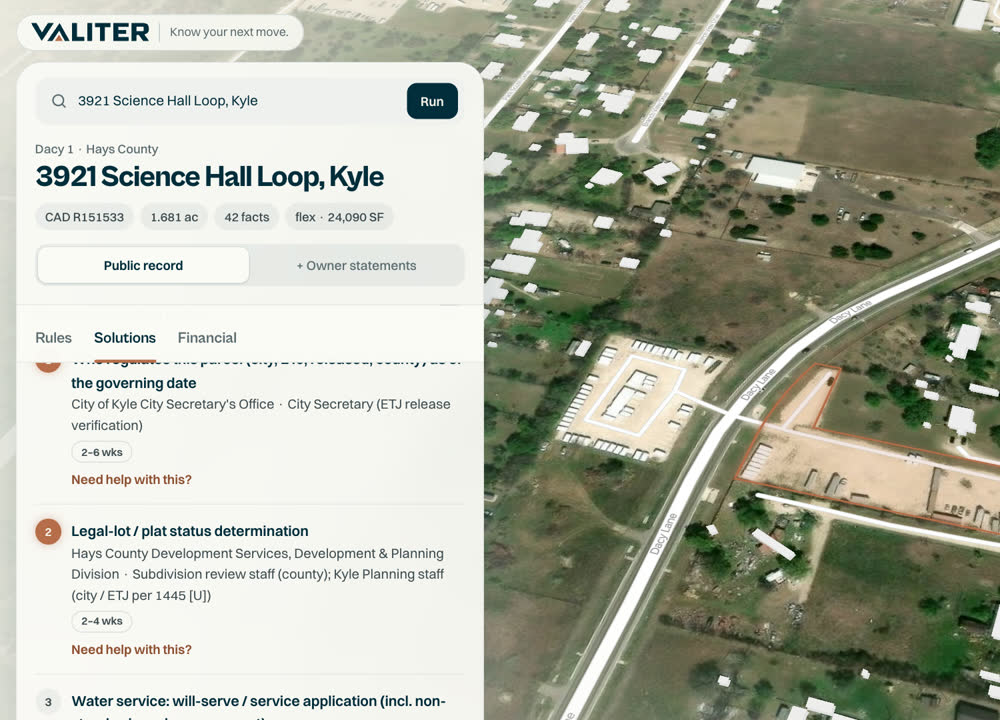
Every approval, in order
Each approval with who decides it, what it depends on, and a typical and worst-case range.
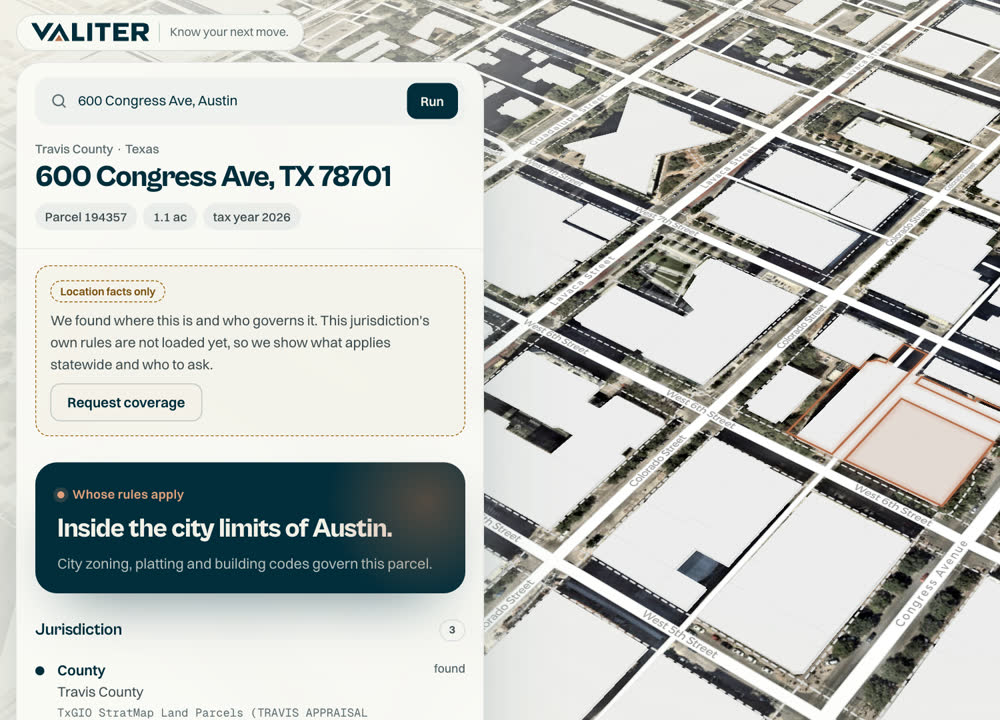
Any Texas address
County, city limits, ETJ, utilities, flood and aquifer zones, read from the public record.
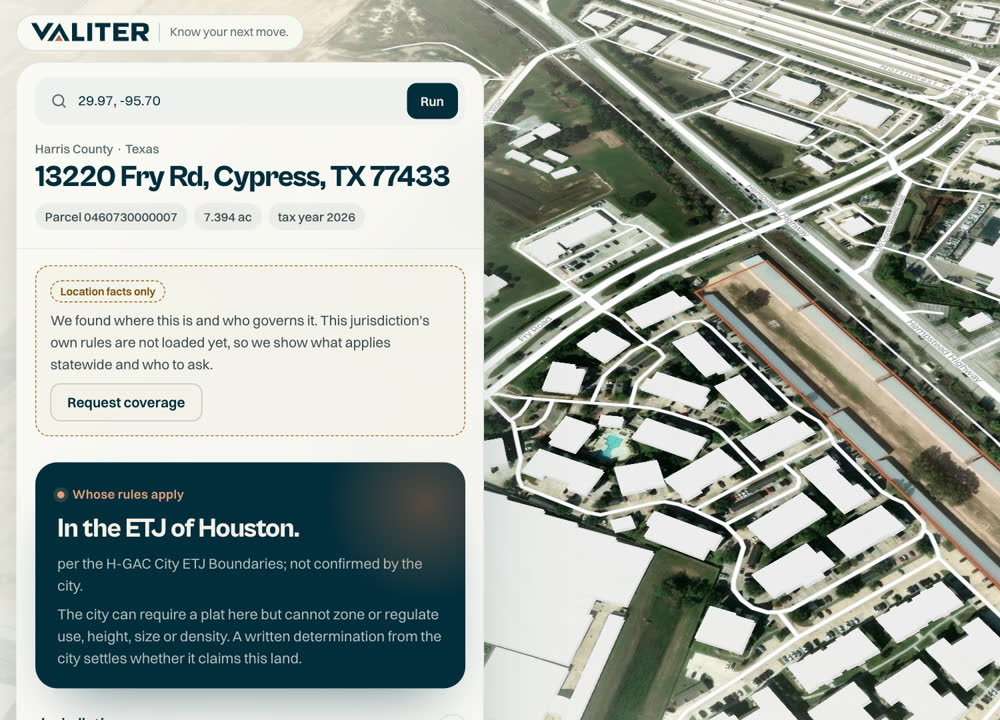
Outside city limits too
In an ETJ or a utility district, it shows what the city can and cannot require, and how to confirm it.
Three layers
Rules. Solutions. Value.
Every rule that applies to your parcel.
- The code and zoning, and which jurisdictions you work through
- Aquifer, watershed and environmentally sensitive land
- Utilities today, and the ones that are coming
- Impervious cover, drainage and floodplain
- Deed restrictions and title
- Vested rights that may hold older rules in place
Path A, B and C, and exactly what to do.
- The order to run each approval
- Who to talk to, office by office
- How to work the city or county portal
- What to push for, and what not to
- The right words for each conversation
- How to read the politics
What each move is worth.
- Time to entitle for each path, best and worst case
- Carrying cost by path, from your own numbers
- What each move saves against the slowest path
- What changes the numbers, and by how much
How you use it
An address in. A plan out.
- 1
Enter a parcel
An address, a parcel ID or a pin on the map, plus what you want to build.
- 2
Read the rules
Every rule that applies, with its source, its status and who decides.
- 3
Choose a path
Path A, B and C, ranked, with who to talk to and what to ask for.
- 4
See the value
Time and carrying cost for each path, and what each move saves.
- 5
Move, and update
As answers come back from the city, county or utility, the paths and numbers update.
Under the hood
Built as infrastructure, not a chatbot.
VALITER is built on a structured model of land rules, not a general-purpose AI guessing at answers.
Every parcel linked to the jurisdictions, districts, maps, records and utilities that touch it, so one address pulls every rule that applies.
Codes, ordinances and state rules turned into structured, versioned rules, each tied to its source text and the date it took effect. When a law changes, the affected parcels change with it.
The approvals a project needs, the order they run in and what each depends on. It builds Path A, B and C and ranks them, deal-killers first.
Time and cost ranges for each path, from public timelines, fee schedules and your own carrying cost, with the assumptions shown.
Practitioners review what the software proposes. Licensed engineers, surveyors and attorneys make the calls that are theirs to make.
Why it matters
A very large market with no map.
Construction is one of the largest industries in the world, and every project starts with entitlement.
Value of US construction put in place in 2025.
Source: US Census Bureau, 2026US local governments, each able to set its own land rules.
Source: US Census of Governments, 2022Share of a new US home’s price that comes from regulation.
Source: NAHB, 2021Singapore construction demand projected for 2026.
Source: Building and Construction Authority, 2026Questions
About the platform.
How is this different from feasibility software?
Feasibility asks what you could build on a site. VALITER answers what it takes to get it approved: the rules, the paths, the people and the money.
Is it AI?
AI reads and structures documents. The answers come from a structured model of rules and records, each tied to its source, and reviewed by people.
Where does it work?
We start in Central Texas and build toward the rest of the United States, Singapore and Indonesia. See our markets.
Waitlist open · Starting in Central Texas
Get on the list before your next site.
VALITER opens to a small group first, starting in Central Texas. Teams with a live site get in first.